
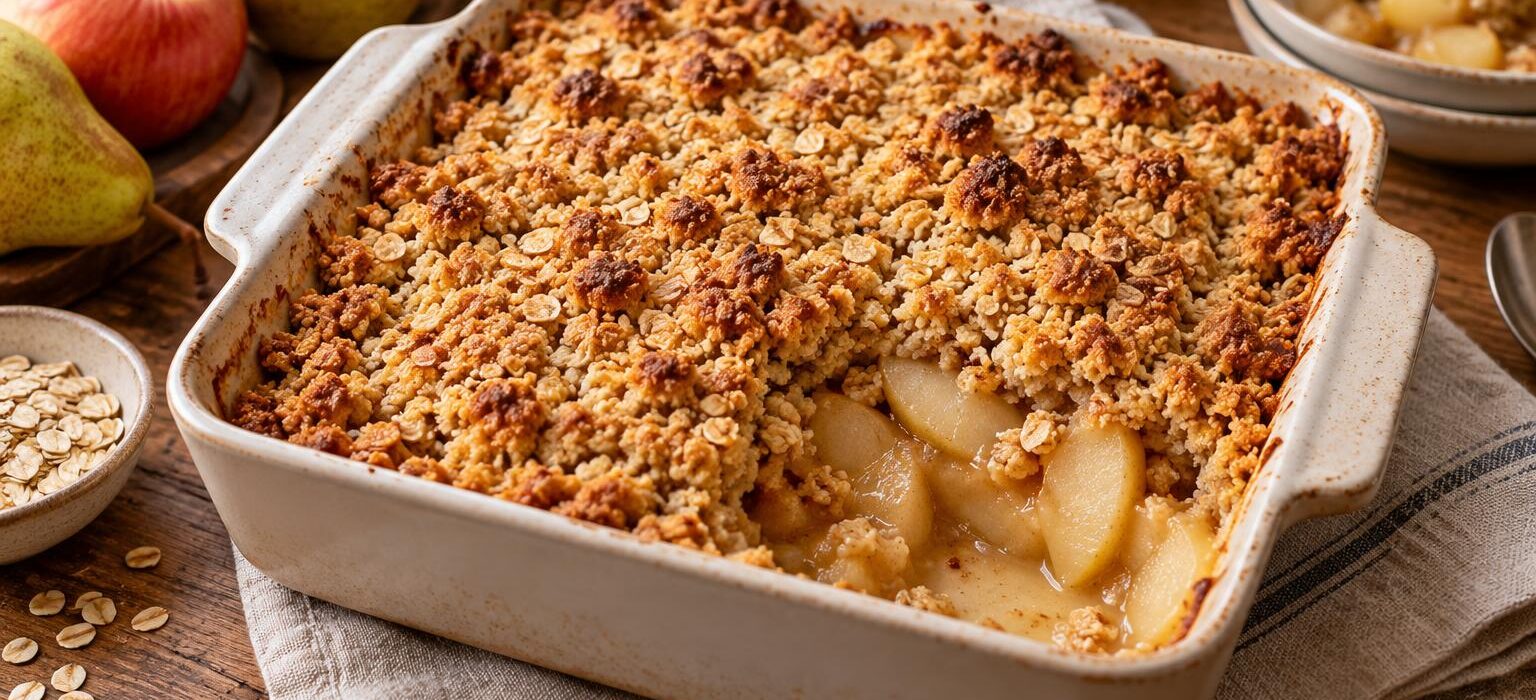
Pear and Apple Ginger Crumble is a very good reason to turn the oven on in October. Soft orchard fruit sits beneath a rough, buttery oat topping, with ginger providing a little warmth rather than a full percussion solo. It is a straightforward pudding for six, built around familiar ingredients and a baking dish rather than specialist equipment.
The balance matters more than the decoration here. Apples bring acidity and structure; pears bring fragrance and sweetness. A little lemon keeps the filling lively, while rolled oats give the topping a pleasantly uneven crunch. Serve it warm, not mouth-scorchingly hot, and let the custard negotiations commence.
Why Pear and Apple Ginger Crumble suits October
British orchard fruit makes this an especially sensible autumn bake. Look for locally grown apples and pears, checking labels rather than assuming everything on the supermarket display has come from a nearby tree. Different varieties and growing conditions affect ripeness, so use the fruit in front of you as your guide.
For choosing pears, Good Food’s pear guide lists their season as September to January and recommends slightly underripe fruit for cooking because it keeps its shape. Conference pears are a practical choice: widely available, fragrant and easy to slice. Avoid rock-hard fruit, but save the very soft, dripping pears for eating rather than expecting them to hold tidy pieces in a hot filling.

Choose fruit that works together
Use 500g prepared pears and 500g prepared apples, weighed after peeling and coring. Buying about 650–700g of each usually leaves enough, although waste varies with fruit size. The prepared weight is the reliable measurement; “three apples” can mean anything from lunchbox miniatures to something with its own postcode.
A tart cooking apple such as Bramley gives a softer, saucier filling. A firm eating apple such as Braeburn keeps more definition. Either works, but a mixture is particularly useful if you want both tender sauce and recognisable pieces. With very sweet eating apples, reduce the filling sugar from 50g to 35g; keep the topping quantities unchanged.
Cut the apples into roughly 1cm slices and the pears into slightly larger, 2cm pieces. Apples often need longer to soften, so this small difference helps the fruit finish together. Remove tough cores completely. Peeling gives a softer texture, though thin, tender skins can stay if you prefer a more rustic pudding.
A topping with proper crunch
The topping combines 150g plain flour, 75g rolled oats, 100g cold unsalted butter and 75g light brown sugar. That gives enough coverage for a roughly 23cm square, 2-litre baking dish without burying the fruit under a duvet of crumbs. A wider dish produces a thinner filling and more crisp surface; a narrow, deep dish takes longer to cook through.
Rub the butter into the flour with your fingertips until you have coarse crumbs with a few small buttery lumps. Stir in the oats, sugar and a small pinch of salt afterwards. Squeeze a few handfuls gently to form larger clusters, then break them up over the fruit. You want rubble, not sand, and certainly not a firmly packed lid.
Cold butter makes this easier to control. If the mixture becomes greasy while you work, put the bowl in the fridge for ten minutes. Rolled oats keep some texture; instant porridge powder will not give the same result. There is no raising agent here because the topping should crumble rather than rise like cake.
Build the filling without making soup
Toss the prepared fruit with the filling sugar, one tablespoon of lemon juice, two teaspoons of ground ginger and one tablespoon of cornflour. The cornflour helps the released juices settle into a light sauce. It is not there to turn the filling into something that can be sliced with a ruler.
Add two tablespoons of water, then spread the fruit evenly in the dish. This modest splash helps the apples start cooking before their own juices emerge. If your pears are unusually juicy, use just one tablespoon. Avoid adding a generous freehand pour: a crumble is forgiving, but it cannot negotiate with a flood.
Scatter the topping loosely and bake at 190°C, or 170°C fan, for about 40–45 minutes. The surface should be golden, juices should bubble at the edges, and a small knife slipped into the centre should meet tender apple. Colour alone is not enough: a beautifully bronzed roof can hide a stubbornly firm ground floor.
The recipe card
Allow 20 minutes for preparation, approximately 45 minutes for baking and 10 minutes for resting. The rest is useful rather than ceremonial: the filling thickens slightly, and the fruit becomes a more comfortable temperature to eat.

- 500 g pears peeled, cored and cut into 2cm pieces; prepared weight
- 500 g apples peeled, cored and sliced 1cm thick; prepared weight
- 50 g light brown sugar for the filling; reduce to 35g for sweet apples
- 1 tbsp lemon juice
- 2 tsp ground ginger
- 1 tbsp cornflour
- 2 tbsp water reduce to 1 tbsp for juicy pears
- 150 g plain flour
- 100 g unsalted butter cold, cubed
- 75 g rolled oats
- 75 g light brown sugar for the topping
- 1 pinch salt
-
Preheat the oven to 190°C (170°C fan). Have ready a roughly 23cm square, 2-litre ovenproof baking dish.
-
Toss the prepared pears and apples with the filling sugar, lemon juice, ground ginger and cornflour. Stir in the water and spread in the dish.
-
Rub the cold butter into the flour using your fingertips until coarse crumbs form. Stir in the oats, topping sugar and salt. Squeeze a few small clusters together.
-
Scatter the topping loosely over the fruit without pressing it down. Bake on the middle shelf for 40–45 minutes until golden, bubbling at the edges and the apples in the centre are tender when pierced. If the topping browns first, cover loosely with foil and continue until the fruit is tender.
-
Rest for 10 minutes before serving. Serve six portions with custard, yoghurt or ice cream if desired.
Fruit weights are after peeling and coring. Buy approximately 650–700g each of apples and pears. Contains wheat, oats and milk. Cool leftovers and refrigerate within 2 hours; eat within 48 hours. Reheat until steaming hot throughout. Accompaniments are optional and not included in the ingredients.
Useful swaps, without losing the plot
For a blackberry variation, replace 150g of the prepared pears with 150g blackberries. Frozen berries can go in straight from the freezer; omit the added water and allow a little extra baking time if the centre is slow to bubble. Their sharper flavour may suit the full 50g of filling sugar even when your apples are sweet.
For extra ginger character, add 25g finely chopped crystallised ginger to the filling and reduce its sugar by about a tablespoon. Cinnamon can replace half the ground ginger if that is what you have, but do not empty the entire spice shelf into the dish. The pears deserve a speaking part.
A firm dairy-free baking block can replace butter by weight. Check that it is suitable for baking rather than a soft, high-water spread. For a gluten-free version, use a suitable plain gluten-free flour blend and certified gluten-free oats, checking all ingredient labels. Texture will vary with the blend, so judge the finished topping by its colour and crispness.
What to serve alongside
Custard is the classic choice, particularly if you have used tart Bramley apples. Thick plain yoghurt or crème fraîche offers a cooler, sharper contrast, while vanilla ice cream supplies its own excellent hot-and-cold argument. Add the accompaniment to individual bowls rather than the whole dish so leftovers remain easier to store.
If you like this fruit pairing but want a different approach next time, try our pan-roasted pears and apples with blackberries. That archive recipe takes the fruit towards a chilled, syrupy dessert; this version is a baked crumble with an oat crust. Same orchard, different evening plans.
Make ahead, store and reheat
You can make the dry crumble topping a day ahead and keep it covered in the fridge. Prepare the fruit closer to baking for the freshest appearance, or toss it with the measured lemon juice and refrigerate it separately for a few hours. Assemble just before baking so the topping does not sit in fruit juice.
Cool leftovers and refrigerate within two hours, covered, then eat within 48 hours. Reheat only the portion you need until steaming hot throughout. An oven at 180°C, or 160°C fan, helps restore the topping; allow roughly 20 minutes for a small ovenproof portion, checking the centre rather than trusting the clock. A microwave is quicker, but expect softer crumbs.
Small problems, simple fixes
If the topping browns before the apples soften, cover loosely with foil and keep baking until a knife passes through easily. Next time, cut the apple a little thinner. If the filling looks loose straight from the oven, give it the full resting time before deciding it needs rescuing.
For pale, soft crumbs, check that the oven was fully preheated and the topping was scattered rather than pressed down. Keep the dish on a middle shelf with space around it. And if your portions refuse to look elegant, excellent: crumble is a spoon pudding, not an architecture examination.